"Once a Submariner, always a Submariner."
Submarine Service Tradition
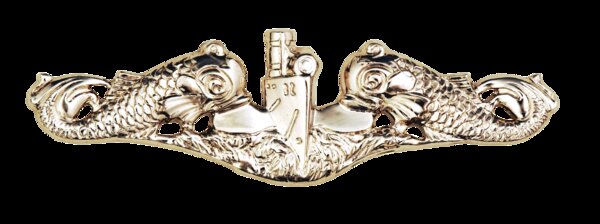
Worn by commissioned officers qualified in submarines. Approved by Acting Secretary of the Navy Theodore Roosevelt, Jr. Gold denotes the officer corps in Navy insignia heraldry.
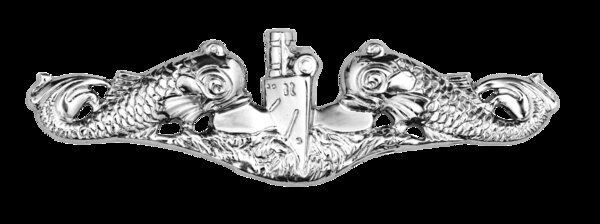
Worn by enlisted sailors qualified in submarines. From 1924 to 1947 the enlisted device was an embroidered sleeve patch; the metal pin above the left breast pocket was authorized during World War II.
The Dolphins trace back to a single letter. On 13 June 1923, Captain Ernest J. King — Commander, Submarine Division Three, and later the Fleet Admiral who would run the U.S. Navy through World War II — wrote to the Secretary of the Navy proposing a distinguishing device for qualified submariners. King included his own pen-and-ink sketch: a shield amidships, dolphins flanking the conning tower, both fore and aft.
His sketch wasn't the final design. The Bureau of Navigation solicited alternatives. Submissions came in combining submarines with sharks, dolphins, and various shield arrangements. The winning design was a fusion of two entries: one by naval-crest specialists Bailey, Banks & Biddle of Philadelphia, and one by midshipman William C. Eddy, originally sketched in 1922 for the Naval Academy class-of-1926 crest.
King writes to SecNav via BuNav. His sketch: shield amidships, dolphins flanking the conning tower.
BuNav solicits designs. Bailey, Banks & Biddle of Philadelphia submits two concepts; one incorporates William C. Eddy's 1922 USNA class-crest sketch.
Acting Secretary of the Navy Theodore Roosevelt, Jr. approves the final design. Officers may now wear the Dolphins.
Qualified enlisted submariners wear an embroidered silk Dolphin on the outside of the right sleeve, midway between wrist and elbow.
Wartime pride drives the change. Enlisted submariners now wear a silver metal pin, matching officers in form if not in color.
The embroidered device moves from sleeve to the same position officers have worn their Dolphins for 23 years: above the left breast pocket, over the heart.
"A starboard angle on the bow view of an 'O' class submarine, proceeding on the surface, with bow planes rigged for diving, flanked by dolphins in a horizontal position with their heads resting on the upper edge of the bow planes."
— Bureau of Navigation, March 1924 — approved design specification
A detail worth knowing: the Dolphins every submariner wears are a jeweler-and-midshipman collaboration. Bailey, Banks & Biddle were professionals; William C. Eddy was a USNA midshipman drawing a class crest. Their sketches together became the most recognizable submarine insignia in the world.
Dolphins were not chosen at random. Across three millennia of seafaring tradition, they are the sailor's friend.
In Greek mythology, the dolphin is the sacred messenger of Poseidon, god of the sea. When the sea-nymph Amphitrite refused Poseidon's hand, it was a dolphin who persuaded her to marry him — and for that service, Poseidon placed the dolphin among the stars as the constellation Delphinus. Byzantine, Arab, Chinese, and European mariners all shared the same belief: a ship escorted by dolphins was promised fair weather and following seas.
But there is a more practical reason the Navy chose the dolphin over the shark or any other sea creature. The dolphin dives and surfaces. The animal embodies the boat's mission. What a submarine does for a living, the dolphin was born to do.
"Gold denotes officer. Silver denotes enlisted. Neither is lesser than the other — silver is the heraldic color of the corps that runs the boat."
— U.S. Navy insignia heraldry tradition
The 1924 specification locks every element of the design in place. Every piece carries meaning.
A starboard bow view of an 'O' class submarine — the design of the pin was fixed in 1924; the boat on your chest is always an O-boat, no matter what hull you actually earned it on.
The planes are in the diving position. The boat is going down. The Dolphins don't depict a submarine on the surface — they depict one about to disappear.
One on each side, bodies horizontal, heads resting on the upper edge of the bow planes. Escorting her down, the way sailor's-friend dolphins were always said to do.
The heraldic split. Gold for officers, silver for enlisted. Same design, same meaning. The boat doesn't run without either one.
No one is handed the Dolphins. They are earned by a process unchanged in its bones for a century. Show up to a boat without them, you are a non-qual — or, in the older and more honest language of the Force, an NUB: Non-Useful Body. You remain a NUB until you qualify.
The qualification process typically takes about 12 months. It never stops during your time on the boat — on-watch, off-watch, underway, pierside. The qual card is your second job.
A point-based record of every system on the boat. Tracked weekly by the Ship's Qualification Coordinator. Miss your points, you go dink.
A senior qualified shipmate walks you, level by level, through the entire boat. Every valve. Every pipe run. Every electrical bus. Every damage-control response. You don't memorize — you know.
Fall behind on points, you are delinquent. Liberty, leave, and privileges suspended. Your shipmates can see the list. Most non-quals only go dink once.
Oral exam before a board of qualified submariners, plus written. They ask anything. They ask everything. The board is not there to pass you; they are there to verify that the boat is safe with you aboard.
The board recommends; the CO concurs. The commanding officer personally pins the Dolphins above your left breast pocket. You are now "Qualified in Submarines." Three words that will follow you the rest of your life.
Your first Dolphins are boat-specific. Transfer to a new boat and you re-qualify on her systems. The designation is for life; the pride is portable; the work starts over.
"I believe it is the duty of each of us to act as if the fate of the world depended on him."
— Admiral Hyman G. Rickover, Thoughts on Man's Purpose in Life, USNI Proceedings, December 1974
A note on the old tradition: for decades the pinning ceremony included "blood pinning" — the CO, then every qualified shipmate present, would press or tack the Dolphins into your chest hard enough to draw blood. It was tolerated and often expected from World War II through the 1990s. The modern Navy has officially ended the practice. The pinning is still the moment every submariner remembers; the tradition has simply moved on from the bruises.
The Dolphins are the foundation. Other pins layer on top to mark specific service, specific patrols, specific decades of membership in the Force.
"Responsibility is a unique concept. It can only reside and inhere in a single individual. You may share it with others, but your portion is not diminished. You may delegate it, but it is still with you."
— Admiral Hyman G. Rickover, Father of the Nuclear Navy
"To perpetuate the memory of our shipmates who gave their lives in the pursuit of their duties while serving their country."
— United States Submarine Veterans, Inc. (USSVI) Purpose Statement
"Once a Submariner, always a Submariner."
— The only motto that really matters
From her commissioning on 21 May 1983 to her decommissioning on 27 February 2017, thousands of sailors walked aboard USS Albuquerque as non-quals and walked off wearing Dolphins — silver or gold, gleaming the same way. Every one of them completed the same qual card, the same walkthroughs, the same board. Every one of them stood in front of a commanding officer and heard the three words "Qualified in Submarines."
If you earned yours aboard SSN-706, we want to hear your story. The Crew Portal is where shipmate contributions build out the record. If you know the CO who pinned you, the date, the patrol — we'd be honored to add it.
Submarine Warfare Insignia (Dolphins) — Naval History and Heritage Command (NHHC). Authoritative source on dates, design specification, and the 1923–47 evolution.
History of U.S. Submarine Warfare Insignia — aboutsubs.com. Detailed design-competition and origin narrative.
MILPERSMAN 1200-010 — Submarine Patrol Insignia — U.S. Navy Personnel Command. Current regulation on layering the deterrent-patrol pin with Dolphins.
United States Submarine Veterans, Inc. (USSVI) — The civilian brotherhood. Membership, purpose, and creed.
Qualified in Submarines — USS Drum — First-person walkthrough of the qualification process as lived.
Jamie's original Dolphins page at ssn706.com — The foundation this tribute builds on. Thank you, shipmate.