LOS ANGELES CLASS · SSN-688 SERIES

LOS ANGELES CLASS

THE BACKBONE OF THE COLD WAR SUBMARINE FORCE

62 boats. Five decades. Every ocean. The most successful nuclear attack submarine in history — and the class that gave USS Albuquerque her home.

62 Boats Built
1976– In Service
360 ft Length · 6,927 Tons
S6G Reactor · 35,000 SHP
3 Flights: 688 / 688I / VLS

Origins & Development

The Los Angeles-class submarine program originated in the late 1960s as the United States Navy confronted a troubling reality: Soviet submarine technology was advancing rapidly. The Victor-class nuclear attack submarines entering Soviet service were fast, quiet, and capable. The existing American force — built around the Permit class and the somewhat larger Sturgeon class — was optimized for quietness and weapons, but not for the high-speed sprint performance needed to intercept fast Soviet submarines and carrier task forces.

The Navy's requirements for the new submarine revolved around a single, dominant characteristic: speed. The proposed SSN-688 design would be built around the new S6G pressurized water reactor, a high-output plant capable of delivering 35,000 shaft horsepower — more than twice the output of the reactor powering the Sturgeon class. This enormous power output would drive the submarine to speeds exceeding 25 knots submerged, making her the fastest operational American submarine to that point.

The design contract was awarded in 1970, and construction contracts were split between the two major American submarine builders: General Dynamics Electric Boat in Groton, Connecticut, and Newport News Shipbuilding and Drydock Company in Newport News, Virginia. This dual-yard approach would be maintained throughout the class's lengthy production run, creating a degree of competition and industrial efficiency that helped manage costs even as the program expanded far beyond its original scope.

The Name That Started a Tradition

The decision to name the lead boat — and the entire class — after the city of Los Angeles was itself significant. American attack submarines had been named after various categories including sea creatures, undersea terrain features, and previous warships. The choice of a major American city's name was a deliberate statement, reviving a naming tradition that had lapsed since World War II. Subsequent boats would bear the names of cities across the United States, creating a political dimension to the program that helped sustain Congressional support through decades of appropriations.

The lead boat, USS Los Angeles (SSN-688), was laid down January 8, 1972 at Newport News Shipbuilding. She was launched April 6, 1974, and commissioned November 13, 1976 — becoming the most capable attack submarine in the world at the moment of her commissioning. The Navy was so satisfied with the design that it immediately ordered additional units, eventually building 62 submarines over a production run that extended from 1972 through 1996, making it the longest continuous production run of any American submarine class in history.

The original unit cost was approximately $220 million per boat in 1970s dollars — a figure that would escalate substantially as the class evolved through three production variants and as inflation drove up material and labor costs. By the final boats, costs had reached well over $800 million each, though the capability delivered had grown proportionately through successive improvements to electronics, sonar, and weapons systems.

The class would prove itself across every major American military operation of the late Cold War and post-Cold War period. Los Angeles-class submarines fired the first cruise missiles in combat during Operation Desert Storm in January 1991, fired Tomahawks during Operation Allied Force over Kosovo in 1999, and conducted strike missions during the opening phases of both Operation Enduring Freedom (2001) and Operation Iraqi Freedom (2003). USS Albuquerque (SSN-706) participated in the Kosovo campaign, firing 10 Tomahawks against Serbian military targets.

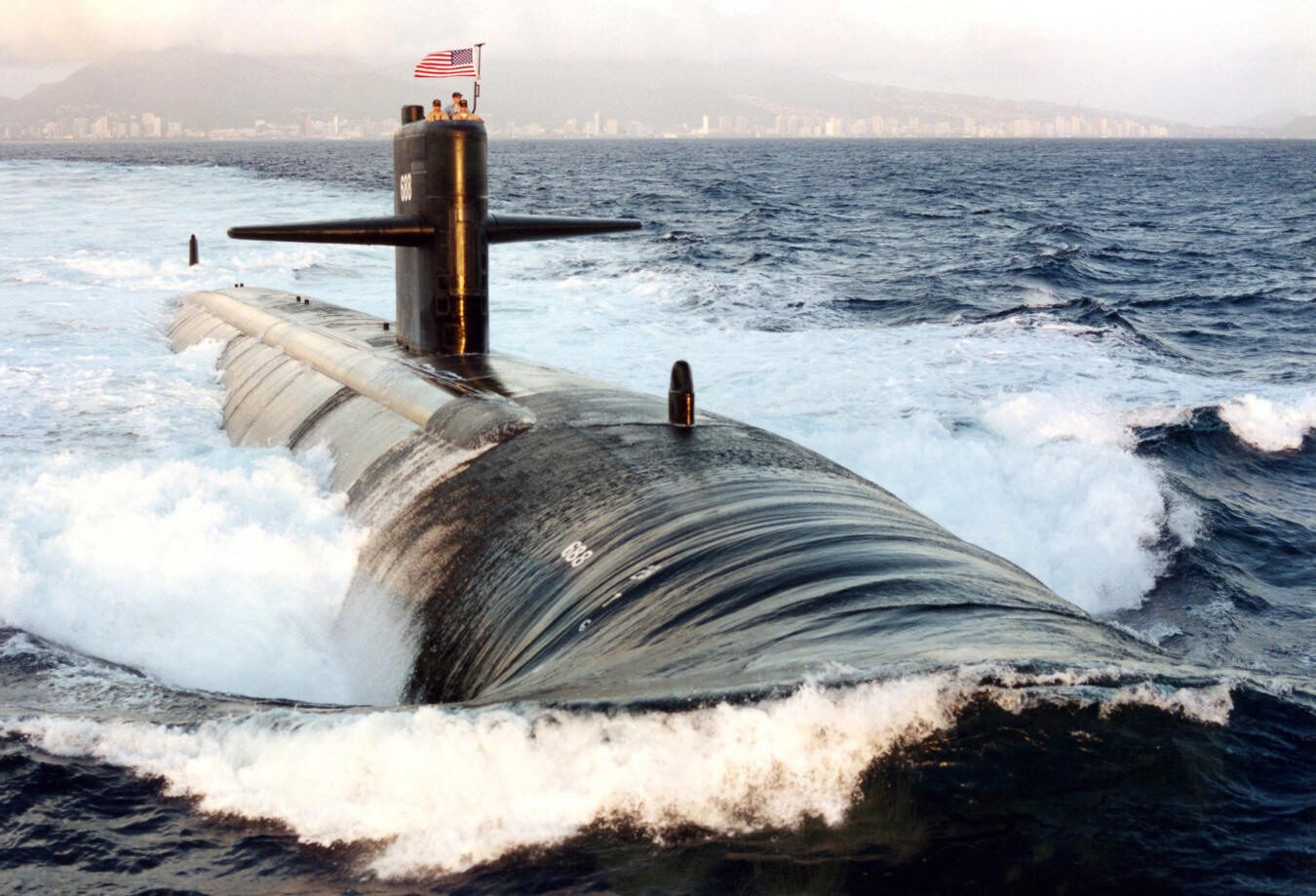
USS Los Angeles (SSN-688), lead boat of the class
USS Los Angeles (SSN-688) — Lead boat of the class, commissioned November 13, 1976 · U.S. Navy photo (via seaforces.org)

Three Flights — Evolution of a Class

Over a 24-year production run spanning 62 boats, the Los Angeles class evolved through three major production variants, each adding significant capability to the basic SSN-688 design. Understanding these flights is essential to understanding what USS Albuquerque was — and what she was not.

31
Flight I

SSN-688 through SSN-718 — The Original Configuration

The first 31 boats, from USS Los Angeles (688) through USS Birmingham (695) and the boats that followed, represent the original Los Angeles-class design. USS Albuquerque (SSN-706) is a Flight I submarine — the 19th boat of the class. Flight I boats have four 533mm torpedo tubes amidships, no vertical launch system (VLS) tubes, and most early boats lacked full under-ice arctic capability. Their weapons suite relied entirely on tube-launched weapons: Mark 48 ADCAP torpedoes, SUBROC anti-submarine rockets, Harpoon anti-ship missiles, and Tomahawk cruise missiles fired through the torpedo tubes. This is precisely how USS Albuquerque fired her 10 combat Tomahawks in 1999 — not through dedicated VLS cells, but through the same tubes used for torpedoes.

32
Flight II / 688I — "Improved Los Angeles"

SSN-719 through SSN-750 — The 688I Configuration

Beginning with USS Providence (SSN-719), the Navy introduced a substantially improved variant widely known as the 688I or "Improved Los Angeles." The defining change was the addition of 12 vertical launch system (VLS) tubes located in the bow section forward of the sail, each capable of carrying a Tomahawk land-attack cruise missile. This gave the 688I boat a dedicated strike payload of 12 Tomahawks without consuming any torpedo tube capacity. Additionally, all 688I boats received upgraded sonar suites (BQQ-5D), improved under-ice arctic capability including an upgraded BQS-15 ice detection sonar and strengthened sail, and enhanced electronics. The 688I variant represented a significant leap in strike capacity over the original Flight I boats and defined the standard for late Cold War American submarine capability.

Final
Flight III — Further Improvements

SSN-751 through SSN-773 — The Refined Configuration

The final production variant, sometimes called Flight III or simply the "later 688I boats," introduced additional refinements including the TB-29 thin-line towed array sonar, the BSY-1 integrated submarine combat system replacing the older Mk 117 fire control, and various electronic improvements. These boats represent the most capable version of the Los Angeles-class design and were still actively deploying through the 2010s. The final Los Angeles-class boat, USS Cheyenne (SSN-773), was commissioned September 13, 1996, closing a production run that had begun in January 1972 with USS Los Angeles.

SSN-706 Albuquerque — Flight I Boat

USS Albuquerque was built before the VLS tubes were added to the Los Angeles class. As a Flight I submarine, her torpedo room was her primary and only magazine. Her four 533mm torpedo tubes carried the full weight of her strike capability: Mark 48 ADCAP heavyweight torpedoes for anti-submarine and anti-surface warfare, Harpoon anti-ship missiles, and tube-launched Tomahawk land-attack cruise missiles. This is exactly how she fired 10 Tomahawks during Operation Noble Anvil in March 1999, striking Serbian military targets from the Adriatic Sea — each missile loaded individually into a torpedo tube, fired, and then the tube reloaded. Despite lacking VLS, she proved that the Flight I design was entirely capable of executing modern precision strike missions.

Technical Specifications

Detailed engineering and performance specifications for the Los Angeles-class submarine. Many figures — particularly maximum speed, test depth, and acoustic signature data — remain classified. Values given reflect unclassified open-source estimates.

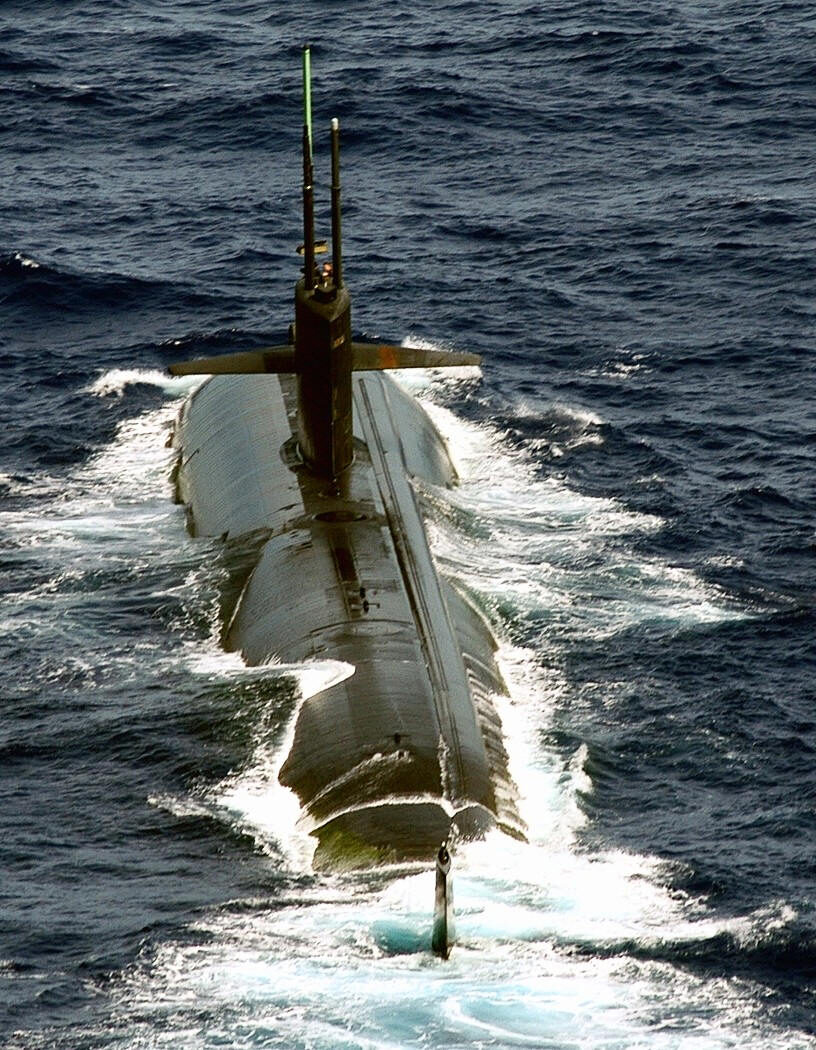
USS Albuquerque (SSN-706)
USS Albuquerque (SSN-706) — Atlantic, September 2003 (post-ERO return) · U.S. Navy photo (via seaforces.org)
Builder Electric Boat (Groton, CT) and Newport News Shipbuilding (Newport News, VA)
Length 360 feet (109.7 m)
Beam 33 feet (10.1 m)
Draft 32 feet (9.8 m)
Displacement (Surfaced) 6,082 tons
Displacement (Submerged) 6,927 tons
Reactor One S6G pressurized water reactor — natural uranium fuel, single coolant loop, ~35,000 shaft horsepower
Propulsion Single shaft, single screw (propeller). Steam turbine reduction gears driving one 5-bladed propeller.
Speed (Submerged) >25 knots (classified; estimated 30–33 knots)
Speed (Surfaced) ~15 knots
Test Depth 800+ feet (classified)
Crew 127 total — 12 officers, 115 enlisted
Torpedo Tubes 4 × 533mm (21 inch) amidships — Mark 67 silver-zinc battery powered, or externally mounted, depending on refit state
Weapons (Flight I) Mark 48 ADCAP heavyweight torpedo · UUM-44 SUBROC anti-submarine rocket · BGM-109 Tomahawk TLAM (tube-launched) · UGM-84 Harpoon anti-ship missile
Weapons (688I / VLS) All Flight I weapons plus 12 × Tomahawk TLAM via VLS tubes in bow section
Sonar — Bow BQQ-5 / BQQ-5D spherical array — passive and active low-frequency sonar, largest bow sonar of any U.S. submarine at time of introduction
Sonar — Towed Array TB-16 (early boats) / TB-29 thin-line (later boats) — passive towed linear array, extremely sensitive long-range passive detection
Sonar — Under Ice BQS-15 — upward-looking ice detection sonar, required for Arctic operations (retrofitted to Flight I boats; standard on 688I)
Combat System Mk 117 fire control (early boats) / BSY-1 integrated submarine combat system (later boats)
Electronics BPS-15 surface search radar · BRD-7 radio direction finder · WSC-3 satellite communications · Multiple antennas deployed via periscope mast
Periscopes 2 × Type 18 (Type 2 on later boats) — search and attack periscopes
Reactor Core Life Approximately 13 years before refueling overhaul; boats typically underwent one ERO (Engineered Refueling Overhaul) during their 30-year service lives
Service Life ~30 years (design goal). Several boats served considerably longer; some Flight I boats served 33+ years.

The S6G Reactor: The Westinghouse S6G pressurized water reactor was the heart of every Los Angeles-class submarine. Producing approximately 35,000 shaft horsepower — far more than any previous American submarine reactor — the S6G gave the 688 class its defining characteristic: speed. The reactor operated at high temperature and pressure, transferring heat through a steam generator to drive the main turbines. A single fuel core lasted approximately 13 years before requiring the expensive and time-consuming refueling overhaul process. Learn more about naval nuclear propulsion history.

Class Comparison

Speed (Relative, Submerged)
Los Angeles (>25 kts)100%
Sturgeon (~26 kts)~95%
Virginia (>25 kts)100%
Seawolf (~35 kts)140%
Displacement — Submerged (Relative)
Los Angeles (6,927t)100%
Sturgeon (~4,777t)69%
Virginia (~7,800t)113%
Seawolf (9,137t)132%
Weapons Capacity
LA Flight I — 4 tubesBase
LA 688I — 4 tubes + 12 VLS+300%
Virginia Block V — VPM (40 VLS)+1000%
Seawolf — 8 tubes (660mm)200%

The Complete Boat List

Every submarine of the Los Angeles class, organized by production flight. USS Albuquerque (SSN-706) is highlighted. Status reflects approximate decommissioning history; a small number of later 688I boats remain in active service as of 2025.

I
Flight I — Original Configuration
SSN-688 through SSN-718 · 31 boats · No VLS · SSN-706 Albuquerque is in this flight
SSN-688
USS Los Angeles
Comm. 1976 · Lead Boat
SSN-689
USS Baton Rouge
Comm. 1977
SSN-690
USS Philadelphia
Comm. 1977
SSN-691
USS Memphis
Comm. 1977
SSN-692
USS Omaha
Comm. 1978
SSN-693
USS Cincinnati
Comm. 1978
SSN-694
USS Groton
Comm. 1978
SSN-695
USS Birmingham
Comm. 1978
SSN-696
USS Indianapolis
Comm. 1980
SSN-697
USS Bremerton
Comm. 1981
SSN-698
USS Jacksonville
Comm. 1981
SSN-699
USS Dallas
Comm. 1981
SSN-700
USS La Jolla
Comm. 1981
SSN-701
USS Phoenix
Comm. 1981
SSN-702
USS Boston
Comm. 1982
SSN-703
USS Baltimore
Comm. 1982
SSN-704
USS City of Corpus Christi
Comm. 1983
SSN-705
USS Albuquerque
Comm. 1982 · Later renumbered
SSN-707
USS Portsmouth
Comm. 1983
SSN-708
USS Minneapolis-Saint Paul
Comm. 1984
SSN-709
USS Hyman G. Rickover
Comm. 1984
SSN-710
USS Augusta
Comm. 1985
SSN-711
USS San Francisco
Comm. 1981 · Grounding 2005
SSN-712
USS Atlanta
Comm. 1982
SSN-713
USS Houston
Comm. 1982
SSN-714
USS Norfolk
Comm. 1984
SSN-715
USS Buffalo
Comm. 1983
SSN-716
USS Salt Lake City
Comm. 1984
SSN-717
USS Olympia
Comm. 1984
SSN-718
USS Honolulu
Comm. 1985
II
Flight II / 688I — "Improved Los Angeles"
SSN-719 through SSN-750 · 32 boats · Added 12 VLS tubes · Full under-ice capability
SSN-719
USS Providence
Comm. 1985
VLS
SSN-720
USS Pittsburgh
Comm. 1985
VLS
SSN-721
USS Chicago
Comm. 1986
VLS
SSN-722
USS Key West
Comm. 1987
VLS
SSN-723
USS Oklahoma City
Comm. 1988
VLS
SSN-724
USS Louisville
Comm. 1986
VLS
SSN-725
USS Helena
Comm. 1987
VLS
SSN-750
USS Newport News
Comm. 1989
VLS
SSN-726–749
23 Additional Boats
All 688I (VLS) configuration · Mostly decommissioned
VLS
III
Flight III — Further Improved
SSN-751 through SSN-773 · Final production variant · BSY-1 combat system · TB-29 towed array
SSN-751
USS San Juan
Comm. 1988
BSY-1
SSN-752
USS Pasadena
Comm. 1989
BSY-1
SSN-753
USS Albany
Comm. 1990
BSY-1
SSN-754
USS Topeka
Comm. 1990
BSY-1
SSN-755
USS Miami
Comm. 1990
BSY-1
SSN-756
USS Scranton
Comm. 1991
BSY-1
SSN-757
USS Alexandria
Comm. 1991
BSY-1
SSN-758
USS Asheville
Comm. 1991
BSY-1
SSN-759
USS Jefferson City
Comm. 1992
BSY-1
SSN-760
USS Annapolis
Comm. 1992
BSY-1
SSN-761
USS Springfield
Comm. 1993
BSY-1
SSN-762
USS Columbus
Comm. 1993
BSY-1
SSN-763
USS Santa Fe
Comm. 1994
BSY-1
SSN-764
USS Boise
Comm. 1992
BSY-1
SSN-765
USS Montpelier
Comm. 1993
BSY-1
SSN-766
USS Charlotte
Comm. 1994
BSY-1
SSN-767
USS Hampton
Comm. 1993
BSY-1
SSN-768
USS Hartford
Comm. 1994
BSY-1
SSN-769
USS Toledo
Comm. 1995
BSY-1
SSN-770
USS Tucson
Comm. 1995
BSY-1
SSN-771
USS Columbia
Comm. 1995
BSY-1
SSN-772
USS Greeneville
Comm. 1996
BSY-1
SSN-773
USS Cheyenne
Comm. 1996 · Final 688
BSY-1

Status key: Gold left border = decommissioned · Green left border = active (approximate as of 2025) · Gold highlighted card = USS Albuquerque (SSN-706). Several later Flight III boats remain active. All Flight I boats (including SSN-706) have been decommissioned. The transition to Virginia-class submarines continues to retire the remaining 688I and Flight III boats.

SSN-706 Albuquerque — Her Place in the Class

USS Albuquerque (SSN-706) was the 19th Los Angeles-class submarine to be built and the 19th to commission. She was laid down at Electric Boat Division, Groton, Connecticut on December 27, 1979 — the same Connecticut shipyard that had produced many of her sister ships and would continue building submarines through the Virginia class and into the future. She was launched on March 13, 1982, and placed in commission on May 21, 1983, with Commander Dennis Wisniewski in command.

Her homeport was Naval Submarine Base New London in Groton, Connecticut — the heart of the American submarine force, a base that has been home to submarines since 1916. From New London, she operated primarily in the Atlantic Ocean, conducting cold war deterrence and surveillance patrols in the North Atlantic and working with carrier battle groups and independent operations across the full breadth of her patrol areas. She later transferred to Pearl Harbor, Hawaii, where she continued operations in the Pacific theater.

The Reactor Overhaul

As a nuclear submarine, USS Albuquerque was built around a finite fuel supply. The S6G reactor core that powered her from commissioning in 1983 had an estimated life of approximately 13 years — which meant that by the mid-1990s, she would require an Engineered Refueling Overhaul (ERO) to replace the reactor core and conduct the massive maintenance and modernization work that accompanied it.

USS Albuquerque underwent her ERO at Portsmouth Naval Shipyard in Kittery, Maine — one of the Navy's premier submarine maintenance facilities. The overhaul, conducted roughly between 2001 and 2003, installed a new reactor core that would power her for the remainder of her service life, updated her electronics and combat systems, and brought her back to full operational readiness. The Portsmouth team completed the work with remarkable efficiency, earning recognition for the turnaround speed. With her new reactor core installed, USS Albuquerque had the energy to serve well into the 2010s.

A Flight I Boat in a VLS World

By the time USS Albuquerque returned from her ERO, the submarine force around her had changed significantly. The 688I boats (SSN-719 and beyond) had carried their 12 VLS tubes for years. The first Virginia-class boats were on the ways at both Electric Boat and Newport News. The force was modernizing rapidly, and USS Albuquerque — a Flight I boat with no VLS tubes, carrying her Tomahawks in the torpedo room — represented an earlier era of submarine design.

And yet she had already proven her combat worth. In March 1999, during Operation Noble Anvil — the NATO air campaign against Serbia during the Kosovo War — USS Albuquerque fired 10 Tomahawk land-attack cruise missiles from the Adriatic Sea at Serbian military targets. Each missile was loaded individually into one of her four torpedo tubes and launched. The operation demonstrated that even a Flight I boat without VLS could deliver meaningful precision strike capability in a real combat environment. The Tomahawk, designed to be tube-launched as well as VLS-launched, was every bit as lethal fired from her torpedo room as from a dedicated VLS cell.

Final Years and Decommissioning

USS Albuquerque continued serving after her ERO through the 2000s and into the 2010s, conducting deployments in both the Pacific and Atlantic. As the Virginia-class boats entered service in growing numbers, the pressure on the older 688 hulls intensified — the Navy needed fewer attack submarines of the old design as modern hulls came online. Flight I boats were the first to go.

USS Albuquerque was decommissioned on February 27, 2017, at Naval Base Kitsap — Bangor, in Silverdale (Keyport), Washington. She had served the United States Navy for 33 years and 9 months, having been commissioned into a world of Cold War confrontation and decommissioned into an era of great power competition, terrorism, and a submarine force transitioning to its next generation. She is now in the Submarine Recycling Program at Puget Sound Naval Shipyard, being carefully dismantled according to strict environmental and nuclear safety protocols.

Key Dates — SSN-706
Laid DownDecember 27, 1979 — Electric Boat, Groton, CT
LaunchedMarch 13, 1982
CommissionedMay 21, 1983 — Naval Submarine Base New London
Combat ServiceOperation Noble Anvil, March 1999 — 10 Tomahawks fired
ERO~2001–2003, Portsmouth Naval Shipyard
DecommissionedFebruary 27, 2017 — Keyport, Washington
Years of Service33 years, 9 months

Legacy & Status

The Los Angeles class redefined submarine warfare for four decades. When USS Los Angeles was commissioned in 1976, the United States submarine force was already the most capable in the world — but the 688 class took that capability to an entirely new level. The combination of S6G reactor power, advanced BQQ-5 sonar, and comprehensive weapons made the Los Angeles-class submarine the gold standard for fast attack submarines globally, a standard that other navies measured themselves against and few came close to matching.

Nicknamed "The 688s" throughout the submarine force, the Los Angeles class served in every major American military operation from Desert Storm to Iraqi Freedom. Los Angeles-class submarines fired the first Tomahawk cruise missiles in combat during Operation Desert Storm in January 1991, establishing the Tomahawk as a weapon that would define American power projection for the next three decades. During Operation Allied Force in 1999, multiple Los Angeles-class boats fired Tomahawks at Serbian targets — including USS Albuquerque (SSN-706), which fired 10 missiles. In 2001 and 2003, the class participated in strikes against Taliban and Iraqi targets respectively.

The class also served in less visible but equally important roles: collecting intelligence on adversary naval forces, conducting surveillance of foreign submarine activity, supporting special operations forces, and providing the continuous undersea presence that underwrites American maritime dominance. These missions, by definition, remain classified, but they represent the vast majority of actual Los Angeles-class deployments over the five decades of the class's service.

As of 2025, most Flight I Los Angeles-class boats have been decommissioned. Some 688I and Flight III boats remain in active service, though their numbers continue to decline as Virginia-class submarines are commissioned in increasing numbers. The Navy's current plan calls for the complete retirement of all remaining Los Angeles-class boats by the late 2020s to early 2030s as Virginia-class production reaches sufficient volume.

The Virginia class is in many ways the direct descendant of the Los Angeles class — sharing the same 533mm torpedo tubes, similar crew size, and comparable speed, while adding modern modular payload capability (including the Virginia Payload Module with 40 additional VLS cells), a life-of-ship reactor that never requires refueling overhaul, and greatly advanced sensor and combat systems. Where the 688 class was a product of Cold War thinking optimized for anti-submarine warfare, the Virginia class was designed for the full spectrum of 21st-century undersea missions.

The Los Angeles class leaves behind an extraordinary legacy. 62 boats. Hundreds of thousands of submarine-days at sea. Every ocean. Every major American conflict for four decades. The men who served aboard them — known simply as The 688 sailors — carried out their missions in complete silence, rarely acknowledged, never publicized, entirely committed. USS Albuquerque (SSN-706) and her 61 sisters represent one of the most remarkable industrial, engineering, and operational achievements in naval history.

Transitioning to Virginia class: The Virginia-class submarine (SSN-774 series) is the direct successor to the Los Angeles class. With 66 boats planned and over 40 commissioned as of 2025, Virginia-class submarines are replacing the 688s one by one across the fleet. The final Los Angeles-class boats are expected to be retired by the late 2020s to early 2030s.

External Resources

Authoritative open-source references for further research on the Los Angeles-class submarine program.

Wikipedia — Los Angeles-Class Submarine
en.wikipedia.org/wiki/Los_Angeles-class_submarine

Comprehensive Wikipedia article covering the full history, specifications, variants, and individual boat entries for all 62 submarines of the Los Angeles class. Well-sourced and regularly updated.

Naval History and Heritage Command
history.navy.mil

Official U.S. Navy history command. Individual vessel histories, award records, and official photographs for all commissioned U.S. Navy vessels including the Los Angeles class.

NAVSOURCE Online — Submarine Photo Archive
navsource.org/archives/08/08688.htm

The definitive photographic archive of U.S. Navy submarines. Individual pages for every Los Angeles-class submarine with dozens of photographs documenting their construction, service, and decommissioning. An invaluable resource for historians and veterans.

GlobalSecurity.org — SSN-688 Los Angeles Class
globalsecurity.org/military/systems/ship/ssn-688.htm

Detailed open-source technical specifications, program history, and operational analysis for the Los Angeles class. Includes information on the three production variants and the weapons and sensor systems.

Naval Technology — Los Angeles-Class Submarine
naval-technology.com/projects/los-angeles-class-submarine

Technical overview and analysis of the Los Angeles class from Naval Technology, covering sensors, weapons, propulsion, and the program's history in the context of global submarine development.

Federation of American Scientists — SSN-688
fas.org/man/dod-101/sys/ship/ssn-688.htm

The Federation of American Scientists' technical profile of the Los Angeles class, including declassified performance specifications and program background.

← Back to Fleet Hub USS Albuquerque Full History →